

HR Manager Resume: What to Include, Common Mistakes, and When to Get Help from Resume Writing Services

Updated: Apr 29

HR professionals are in high demand, but that doesn’t mean landing the right role is easy. According to the U.S. Bureau of Labor Statistics, employment for human resources managers is projected to grow 5% over the next decade, with thousands of openings each year driven by organizational expansion and the need for stronger people management strategies.
At the same time, as companies place more emphasis on talent acquisition, employee experience, and retention, expectations for HR leaders are increasing.
This creates a disconnect: while opportunities are growing, competition for top HR roles is becoming more selective. Employers are no longer just looking for HR experience: they want candidates who can clearly demonstrate measurable impact on hiring, retention, and business performance. Many qualified HR professionals struggle to translate that impact into a resume, which leads to missed opportunities despite strong backgrounds.
Your resume can either open doors or hold you back. And in this guide, we’ll show you how to make sure it’s working in your favor.
We’ll cover:
Why HR manager resumes are difficult to write
What to include in your resume
What a strong HR manager resume looks like
Common mistakes that hurt your chances
When it makes sense to use a professional resume writing service
What Makes HR Manager Resumes Difficult To Spin Up
HR manager resumes are uniquely challenging to write.
Unlike roles where outputs are easier to quantify, HR sits at the intersection of people, operations, and business strategy. Much of the work happens behind the scenes: improving processes, supporting leadership, and influencing employee experience, which makes it harder to clearly communicate impact on paper.
A strong HR resume needs to go beyond listing responsibilities. It needs to show outcomes.
When reviewing a resume, hiring managers expect to quickly understand:
The size and scope of the workforce you’ve supported
The programs and initiatives you’ve led (recruitment, onboarding, retention, DEI, etc.)
How you’ve influenced leadership decisions and organizational strategy
The measurable impact of your work on hiring efficiency, engagement, and performance
At the same time, HR professionals often wear multiple hats. You might be responsible for recruitment, employee relations, compliance, and performance management. Translating that scope into a concise, one-page (or two-page) document is where many candidates struggle.
It’s also common to rely on generic language like “managed HR processes” or “supported employees,” which doesn’t clearly communicate value or differentiate you from other candidates.
The result? A resume that undersells your actual impact.
What Should An HR Manager Put on Their Resume?
An HR manager’s resume should focus mainly on three things:
Results
Scope
Strategic impact
Here are the key sections and what to include in each:
#1 Summary
Your summary should quickly position you for your target role.
Instead of a generic overview, focus on:
Years of experience
Industry or specialization (e.g., tech, healthcare, corporate, etc.)
Key strengths (e.g., talent acquisition, employee engagement, HR strategy, compliance)
1–2 measurable highlights
This section should make it immediately clear what type of HR role you’re targeting and what you bring to the table.
#2 Professional Experience
This is the most important section of your resume.
Each role should clearly communicate:
The size of the organization or workforce you supported
Your role in driving HR initiatives and processes
The outcomes you achieved
Strong bullet points focus on impact. For example:
✅ Reduced employee turnover by 22% by implementing a new onboarding and engagement strategy
✅ Led full-cycle recruitment for 50+ roles annually, decreasing time-to-hire by 30%
#3 Skills
Your skills section should reflect both technical tools and HR competencies, such as:
Tools: Workday, BambooHR, SAP SuccessFactors, ADP
Core skills: Talent acquisition, employee relations, performance management, compliance
Strategic skills: Workforce planning, leadership development, organizational design
⭐ TIP: Use a resume scanner to compare your resume with your target job description. This helps identify missing keywords and skills, which is especially important for passing Applicant Tracking Systems (ATS).
#4 Education
Include relevant degrees or coursework, especially if aligned with your field.
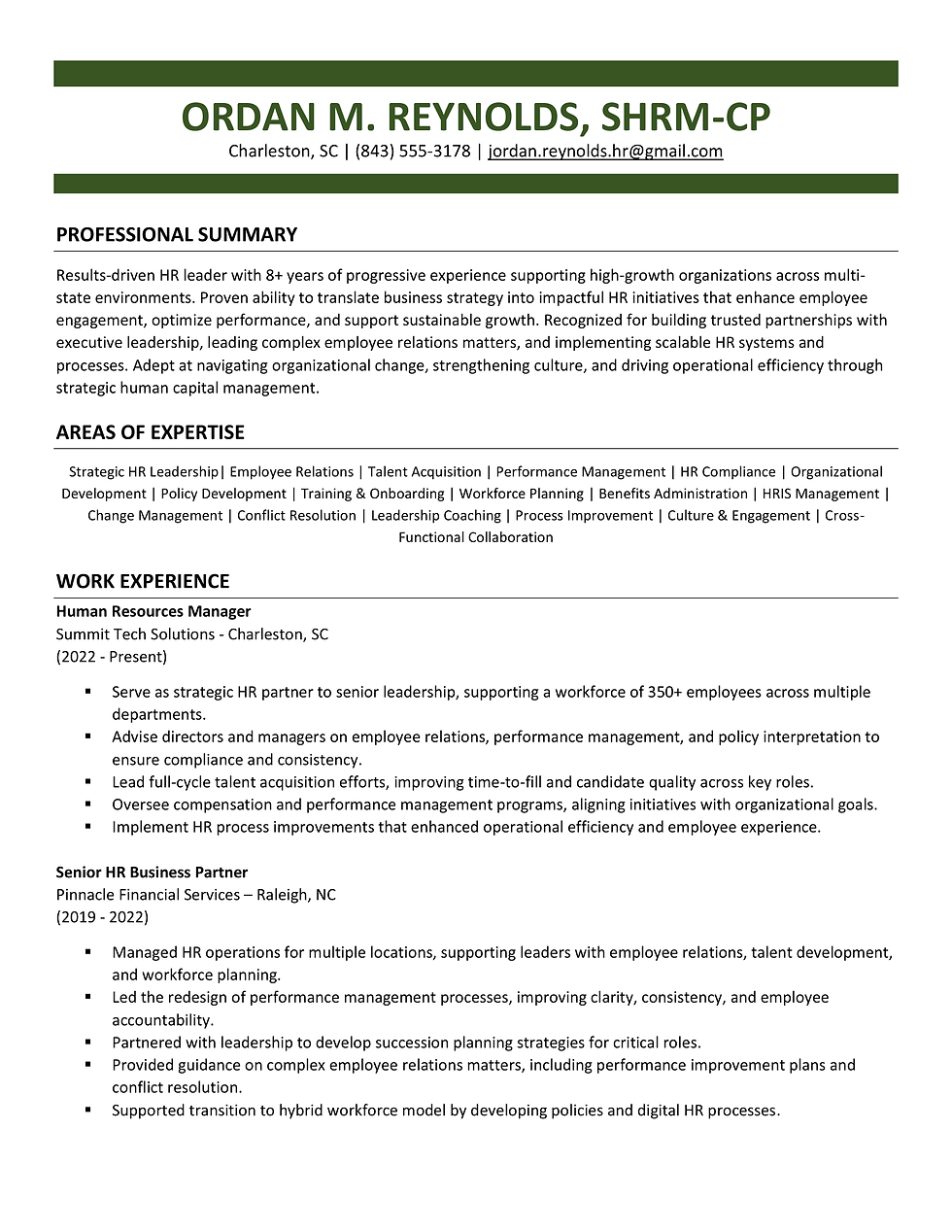
What Does An HR Manager Resume Look Like?
A strong HR manager resume is clear, structured, and results-driven.
Rather than trying to include everything, your goal should be to make your experience easy to scan and immediately impactful.
Here’s what that typically looks like:
Clean formatting with clearly defined sections
Bullet points that start with action verbs and include measurable results
Emphasis on achievements rather than responsibilities
For HR managers specifically, strong resumes often highlight business impact (not just HR tasks), include metrics related to hiring, retention, and employee engagement, demonstrate strategic involvement with leadership and decision-making, and avoid overly generic HR jargon without context.
HR Manager Resume Sample

Common Mistakes When Writing A Resume
Many HR manager resumes fall short not because of a lack of experience, but because of how that experience is presented.
Some of the most common mistakes include:
#1 Focusing on Responsibilities Instead of Results
Listing tasks like “handled recruitment” or “managed employee relations” doesn’t show impact.
Hiring managers want to understand outcomes.
Instead, ask yourself:
What results did you bring to the table in each project you led or participated in?
Then turn that answer into compelling bullet points using measurable results.
#2 Overusing Generic Buzzwords
Terms like “people-oriented,” “team player,” or even “strategic HR partner” lose meaning when not supported by specifics.
Without context or results, they make your resume less scannable and don’t add any value.
Instead, focus on action verbs and pair them with outcomes.
#3 Lack of Measurable Achievements
Metrics are critical for HR roles.
Without them, it’s difficult to assess hiring efficiency, retention improvements, and employee engagement impact.
Here are examples of measurable achievements you can include:
Time-to-hire reduction: Shows efficiency in recruitment
Turnover rate improvement: Demonstrates impact on retention.
Employee satisfaction scores: Reflects engagement and culture improvements.
Training completion rates: Highlights development initiatives.
If you put in a little effort, there are many ways you can add value to your resume through measurable achievements.
#4 Not Tailoring the Resume for the Target Role
HR roles vary widely: from generalists to HR business partners to talent acquisition specialists.
Submitting the same resume for every role can significantly reduce your chances of getting interviews.
Instead, use a resume scanner to scan the job description and compare it with your resume. It will identify skill gaps specific to the target role, which you can add to your resume to match more closely the job you are applying for.
#5 Making the Resume Too Dense or Too Vague
Too much detail can be overwhelming, while too little detail can make your experience unclear.
Striking the right balance is key, but often harder than it seems.
Try:
Fitting your resume into one page (or two for senior candidates)
Using bullet points with up to 200 characters each to improve readability
Using numbers to showcase measurable achievements
These three simple rules will help you hit the sweet spot!
When to Use a Resume Writing Service
If you’re not getting interviews, even with solid HR experience, your resume may be the issue.
HR resumes require a specific balance of clarity, metrics, and positioning. Small changes in wording, structure, or focus can make a significant difference in how your experience is perceived.
You may want to consider a professional resume writing service if:
You’re applying consistently but not hearing back
You’re targeting more senior roles (HR Manager, HR Business Partner, Director)
You’re transitioning into a more strategic or specialized HR role
You’re unsure how to quantify your impact or position your experience
A professional resume writer helps translate your experience into a format that aligns with what hiring managers and applicant tracking systems are looking for.
Rather than guessing what works, you’re working with a resume that’s been strategically written to stand out.
Meet TopStack And Go From Filtered Out To Stand Out
Writing a strong HR Manager resume isn’t just about listing your experience: it’s about positioning it in a way that clearly communicates your impact, leadership, and ability to deliver results.
Even small changes in how your experience is structured, worded, or quantified can significantly affect how hiring managers perceive your application. And when you’re competing against other experienced candidates, those differences matter.
If you’re not getting the response you expected, working with a professional resume writer can help you bridge that gap.
At TopStack, our writers specialize in transforming project management experience into resumes that are clear, results-driven, and aligned with what recruiters and hiring systems are looking for. Instead of guessing what works, you’ll have a resume built to stand out from the start.
Our services are rated 4.9 out of 5 on a 3,500+ reviews. Beat applicant tracking systems, present yourself with confidence, and get hired faster. Check out our services and get started for free today!


